Wednesday, August 23, 2017

Wednesday, August 23

Today's Content:
  • Continuous Improvement: Getting Started with Mission Statements
  • Falcon Welcome: Celebrating Our New Campus
Welcome back Falcons!  It has been a long time coming, but 2017-18 school year is finally here.  We have much to anticipate, and much to celebrate.  Let's get started!

Falcon Focus: Getting Started with Mission Statements


As our classes get underway, several teachers have asked for assistance with Mission Statements.  Mission Statements are critical to effective continuous improvement, so you definitely want to consider this in your first few weeks of instruction.  

Here's your Mission Statement refresher, in three easy steps.  

Step 1:  Why write a mission statement?  As a group, we must know and understand our purpose. Only with clear goals in mind can we align our attitudes and actions to achieve group success.  Putting our mission into words helps us and our students stay focused on the reason for being in our classes - to learn, of course!  Everything in your class should ALWAYS come back to your mission, and involving the students in that process helps them take ownership in their own learning.

Not to mention it is a district and school expectation, so there's that, too.   

Step 2:  How do I write a mission statement?  There are three key questions that your students and you need to consider and discuss:  1) Why are we here?  2) What do we have to do well together?  and 3) How will we make it happen?  These questions help students narrow, refine, and articulate their thinking on why we are at school in the first place, and how we can achieve the goals we set forth.

Need more guidance?  Check out this Google Slides presentation; it will walk you through the Mission Statement writing process.  Feel free to make a copy and edit as you see fit.


Example Mission Statements


Step 3: Now that we've written our mission statement, what do we do?    A mission statement should be a cornerstone of your classroom culture, a mantra.  Revisit it often.  Students (and teachers) should use it to help guide their actions rather than hinder their learning and classroom environment.  If students know it well enough, they will even use it to keep each other in check.  

Click on the links below to view two examples from last year of students interacting with their mission statements.

Mrs. Grosenbach’s ELAR Recites Mission Statement


Falcon Focus: Celebrating Our New Campus

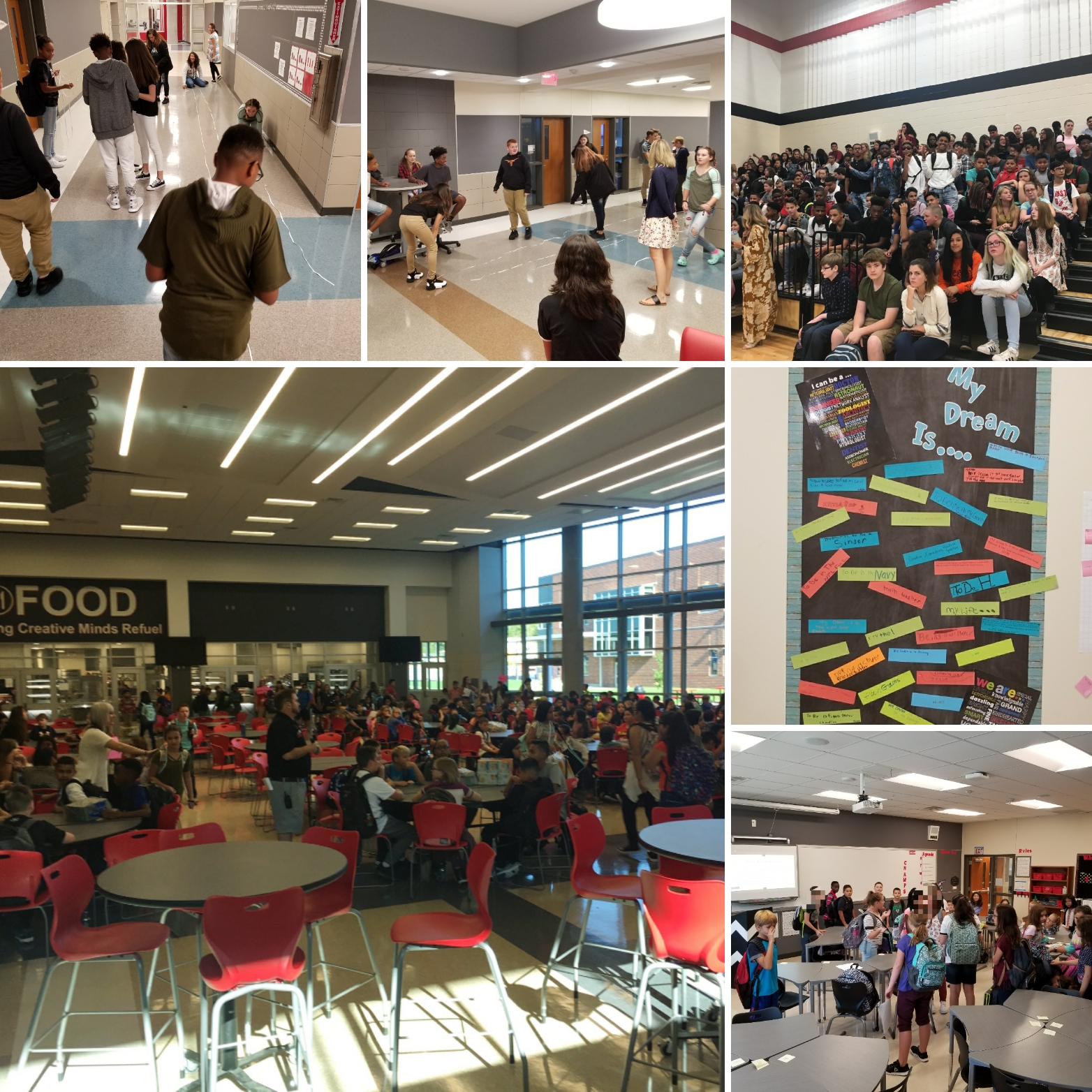
It has been an amazing start to the year!  Students are learning their way around the building, and our new space is a new beginning for everyone.  Please enjoy a few pics from the first few days, and if you have something to celebrate, share it on Twitter using #NRMSProud.  (Just be sure to check the photo permission list before posting students' pictures.)  Let's share our story with the community, and let them see the great things happening at our school.

PD Shenanigans

NRMS Ribbon Cutting
1st Day Excitement


If have any questions or would like some help implementing these or other strategies, please let me know.  And remember...

It's a great day to be a Falcon! 

Wednesday, March 1, 2017

Wednesday, March 1

Today's Content:
  • Questioning Strategies:  Socratic Seminar in Math
  • Literacy Focus: Authentic Reading Opportunities in 6th Grade
  • Continuous Improvement: PDSA Examples in Classrooms
Hard to believe it's already March.  This Spring semester has brought about many new strategies and creative learning opportunities for our students.

Falcon Focus: Socratic Seminar in Math


If you have never tried Socratic Seminar in your class, you should.  This student led academic discussion strategy gives students a voice by teaching them to question the world around them, clarify their opinions, support ideas with evidence, and disagree respectfully.   Basically, it makes them think - on their own.  I loved using this strategy in my ELAR class...but Math?  Who does that?

Well, Elizabeth Pauley did, with all of her math classes at the beginning of the Spring semester.  First, the students read various articles about growth mindset in math and the role of failure in learning. Different students had different articles, and practiced close reading strategies to help them process their reading. Then on day 2, they shared their thoughts on trying and failing in math, school, and life in general.  Their conversation covered the topics of growth mindset, perseverance, and how to get help from your teachers. 

Their conversation was deep and meaningful.  Please take a few minutes (four) to watch the video from their discussion.  It was an amazing and authentic discussion by some students who were really changing their viewpoints on some things.  Enjoy.


Falcon Focus: Reading Fun in 6th Grade

6th grade reading has been busy exposing students to new titles and connecting them to published authors.   On Valentine's Day, students had the opportunity to "speed date"...books!  Kathy Harvell and Kylie Norrell transformed the hallway into a reading cafe.  Students visited each table for a limited amount of time and were able to browse different genres to find books they wanted to read.  As the bell rang, I overheard at one table, "Aw, I wanted to keep reading!"  #TeacherWin


If falling in love with a book wasn't exciting enough, the 6th graders celebrated #WorldReadAloudDay on February 16 by connecting with published authors.  Throughout the day, Reading classes Skyped with authors, as they read aloud from one of their books, shared their own favorite reads, and answered student questions.  The authors who "visited" were:

Brooks Benjamin, My Seventh Grade Life in Tights
Sarah Aronson, Beyond Lucky
Janet Summer Johnson, The Last Great Adventure of the PB&J Society
Lee Gjertsen Malone, The Last Boy at St. Edith's
Miriam Spitzer Franklin, Extraordinary
Corey Ann Haydu, Rules for Stealing Stars

Hear about this experience from the students themselves by visiting the Facebook Live broadcast from Karen Teeters & Rashel Larson on #DigitalLearningDay, and check out the pictures below.


Falcon Focus: PDSA Examples in Classrooms

February has drawn to a close, and we already have so many different examples of PDSA.

Need some inspiration?  Use your spring semester Falcon Walk to learn about how a colleague is utilizing PDSA in their class.  Ask your friendly neighborhood coach for some assistance in brainstorming ideas.  Or you can just check out just a few of the campus examples below.

The "study" section includes both the assessment data and the plus/deltas from the students.

This PDSA board offers some ideas for improvement to be used in the "Do" section.


Not enough space?  Use your cabinets!

Or your white board space.  You can revise your PDSA with the simple eraser.

You may have seen this one before, but notice the Tic Tac Toe board under "Do".  Students choose how they are going to support their own learning by making a tic-tac-toe.  See a sample Tic-Tac-Toe below.


The "Do" here includes both student and teacher actions.  This way, when it's time to "Study" there is much to discuss as far as what worked and what didn't.

Since I first pulled these pictures a week ago, there are already so many more fantastic examples of PDSA being posted in classrooms and used to steer learning.  I will continue to gather ideas for you and share them with the campus.  There is a lot going on right now, and I am happy to support you however I can.  You are all doing an amazing job.  Thank you!

If have any questions or would like some help implementing these or other strategies, please let me know.  And remember...


It's a great day to be a Falcon!

Wednesday, January 4, 2017

Wednesday, January 4

Today's Content:
  • Instructional Strategies for ELLs:  Z Charts and Canva
  • Special Education: Teacher Swap in Co-Teaching
  • Falcon Way: #WheelchairChallenge and Other Empathy Building

Happy New Year!  And what a year it's been so far! Has this semester flown by as quickly for you as

it has for me?  With Falcon Way and the many other systems we have built up for our students and our campus, it has been a whirlwind.  Many have dedicated their time and effort (did I mention time? and effort?) to make a difference for our kids, and there are countless stories of the changes that are taking root.  I can’t possibly do you all the justice you deserve in my (incredibly overdue) blog post, so I’m just going to hit three of the areas where a lot of work has already made a difference.


Falcon Focus: Instructional Strategies for ELLs

The SIOP team has been hard at work this year identifying and putting into practice several different strategies specifically designed to improve the learning of our ELL students.  Most recently, the team has worked on Z Charts as key strategy.  Several teachers have already used these graphic organizers in all classes to facilitate the reading, listening, speaking, and writing of our students, with a lot of success!   

The best part about SIOP strategies is that they represent best practice for all of our students, providing opportunities discussion, collaboration, and differentiation.   

Most recently, SIOP members used Z Charts themselves to jigsaw the six key SIOP instructional features using Canva (as taught by Rashel Larson last week), Google Slides, and Power Point.  The six key features include:

·       Content Objectives
·       Language Objective
·       Age-Appropriate & Educationally Appropriate Content Concepts
·      Clear and Meaningful Supplementary Materials
·       Adaptation of Content to Student Proficiency Levels
·       Meaningful Activities That Integrate Language Practice


Click on the Prezi below to learn about the six key SIOP Instructional Features and check out the professional Canva graphics created by our teachers.  


If you have any questions about how these features would work in your own classroom, please ask Regina Walker or Mary Terry.


Falcon Focus: Taking Risks in Co-Teaching

Many of our teachers have been working hard is in our co-teach classrooms this semester as well.  Even though our we do not have the ideal co-teach structure in place, the cohort's goal is to create the best possible co-teach environment for our students.  Through our Google classroom, co-teachers are learning more about the six co-teach models and collaborating with their co-teacher on ways to make the models work for them.  A few teams have worked as target teams, opening themselves up to trying different co-teach models in less-than-ideal situations – and making it work like gangbusters!  I’m very excited about the conversations going on in our Google classroom and the resulting learning in classrooms. 

This past week, two of our teachers took it a step farther by doing a teacher swap.  Yes, you read correctly – a teacher swap. 

What's a teacher swap, you ask?  Well, in this case, it was Jonie Dodson and Teresa Davis trading places to gain a better understanding of the expectations facing the other teacher.  With the hope of establishing a clearer path to co-teach collaboration, Mrs. Dodson and Mrs. Davis took a risk and gave up control of their schedules for the day.  In the video below, check out the hard work being accomplished in Ms. Dodson's class, with Mrs. Davis at the helm:


Both teachers appreciated having the opportunity to truly see what some of the constraints are, and gained some perspective.  According to Mrs. Davis, "To step into Jonie's shoes for a day, I realize what she's been telling me...and what most of my other co-teachers tell me...that the co-teach class functions and performs much differently than the other classes, even though it is the same lesson.  So for them, in a very real way, the co-teach class is the first time they've taught that lesson each day."

Building empathy for the others in our building is the first step to true collaboration, and we are well on our way.


Falcon Focus: #WheelchairChallenge

Speaking of empathy, hats off to Sarah Peltier and the Acceptance House for the creation of the #WheelchairChallenge.  We had 9 volunteers so far, and all have told of sore arms, unexpected challenges, and surprise (occasionally overextended) kindness.  


As we continue our work to build the Falcon Way, I hope you've found the challenges to be rewarding and look forward to many more celebrations in the new year!  Enjoy some of the celebrations from the the fall semester in the video below.  (Spoiler alert: There's a video of Mr. V participating in the #WheelchairChallenge towards the end!)


If have any questions or would like some help implementing these or other strategies, please let me know.  And remember...


It's a great day to be a Falcon!

Wednesday, October 26, 2016

Tuesday, October 25

Today's Content:
  • Tier 1 Priorities:  Primary Sources
  • Tier 1 Priorities: Close Reading
  • Special Education: Co-Teach Cohort

Falcon Focus: Primary Sources

Primary sources continue to be a focal point of instruction in Social Studies.  But between complex content, dated language, and (gasp) cursive handwriting, primary sources can pose an especially challenging read for our students.

So how do we make that historical, necessary content more accessible to students?  One way is to make the learning authentic--to find a way to help the students empathize with the author, subject, or content within the piece itself.

Recently, 8th grade American History investigated the Boston Massacre crime scene.  Students had the opportunity to play detective by analyzing historical artwork depicting the event; observing the crime scene itself, complete with "blood" and "clues";  and reading first-hand accounts from individuals present at the Massacre.

Students work in groups to analyze the crime scene of the Boston Massacre
If it seems like to much information for students to process, it's not.  Different crime scene elements were broken out into stations, and each station provided scaffolds to help with content comprehension.  The written documents had been reenacted and performed for students to listen to or watch while or after reading the original document.  Both the artwork and the crime scene were paired with guiding questions to help students navigate the different types of information being shared.  And all throughout, students had access to each other as they grappled with the different perspectives of the Boston Massacre.

Students use guiding questions to analyze visual primary sources

To help students with comprehension of the difficult language, teachers "performed" each monologue.

In 7th grade Texas History, students have also recently used primary sources, as they are learning about Stephen F. Austin's colonization into Spanish Texas.  In small groups or partners, students read several different letters that had been written to request a spot in Austin's new colony.  Then, students evaluated each individual against a set of criteria to determine whether or not they were a good "fit". The primary source letters presented challenging language and unfamiliar context.  So what helped these students make meaning from the text?

First, the amount of the text is manageable.  Each letter written to Stephen F. Austin fit nicely on a half-page, so students could grapple with the text without getting burned out on the difficulty.

Students grappling with primary sources
More grappling
Evaluating each colony candidate against criteria


In addition, students had the opportunity to read these aloud.  For our auditory learners, hearing the reading will help them process the information; plus, we get to hear students try on some really fantastic accents!  The student below is reading from except A above, "Buffalo" Jones.


Falcon Focus: Close Reading

You may have heard this before, but we are all teachers of reading.   Close reading is main pillar of ELAR instruction, and different variations of it can and should be used in any content area.

When students close read, the goal is for students to go back into a text and use text evidence to support their response to a very targeted question.  The success of the close reading activity relies heavily on the question.  In ELAR, there are 4 specific question levels:

1) What does the text say?  (comprehension)
2) What does the text mean? (making inferences/drawing conclusions)
3) How does the text work? (author's craft)
4) What does the text inspire you to do? (writing piece or other response)

After attending the content professional learning days, 6th grade Reading tried out a strategy called "SpongeBeyonceBananaPants".  (Yes, that's the actual name of this strategy.  No, it has no meaning to the activity other than students remember it. No, Kathy and Kylie did not make it up.)  In this strategy, students use a graphic organizer interact with the text, which in this case, is a poem.

Teacher designed questions require students to go back into the text multiple times to support their responses.


In Sherry Grosenbach's class, students used specific plastic flags to interact with the text in a different way.  In addition to writing on the passage (in this case, a speech), students used the flags to identify different elements of the speech in a hands-on way.  Then when it was time for deeper analysis, students used their tactile practice with the text to move back through it more efficiently.
Close reading can be tactile, too!
If you don't have fancy flags, simply substitute sticky notes or paper clips.  In the future, we will be talking more about how different close reading strategies can help support students in your content areas, as well.  Stay tuned!


Falcon Focus: Co-teaching Cohort

This year all of our teachers with a co-teach classroom (both general ed and special ed) are participating in a flipped year-round cohort.  While we know there are limitations to our schedule, we also believe that we can do better for our students.  Therefore, our goal is to improve our co-teach practice by finding ways to creatively implement co-teach best practices.

Throughout the year, we will be reviewing the six co-teach models: one teach, one observe; station teaching; parallel teaching; alternative teaching; teaming; and one teach, one assist.  The bulk of the work is happening in Google Classroom, with some observation and coaching time for some.

Don't have a special education co-teach classroom, but still want to learn more?  You are welcome to participate in the Google classroom with us; just email me and I will get you more information.


If have any questions or would like some help implementing these or other strategies, please let me know.  And remember...


It's a great day to be a Falcon!

Tuesday, September 20, 2016

Tuesday, September 20

Today's Content:
  • Continuous Improvement:  Mission Statements Schoolwide
  • Digital Communication: Band Weekly Webinars

Falcon Focus: Mission Statements Schoolwide

Over the past several weeks, Falcons have created mission statements to clarify our goals and to provide purpose to our day-to-day.  With personalized phrasing as diverse as our population, these mission statements will serve as the foundation of our work this year, both as a campus and in our classrooms.

For mission statements to work, stakeholders must have ownership in the writing process. This allows individuals to recognize the why behind the work, and creates a focal point when distractions become, well, distracting.

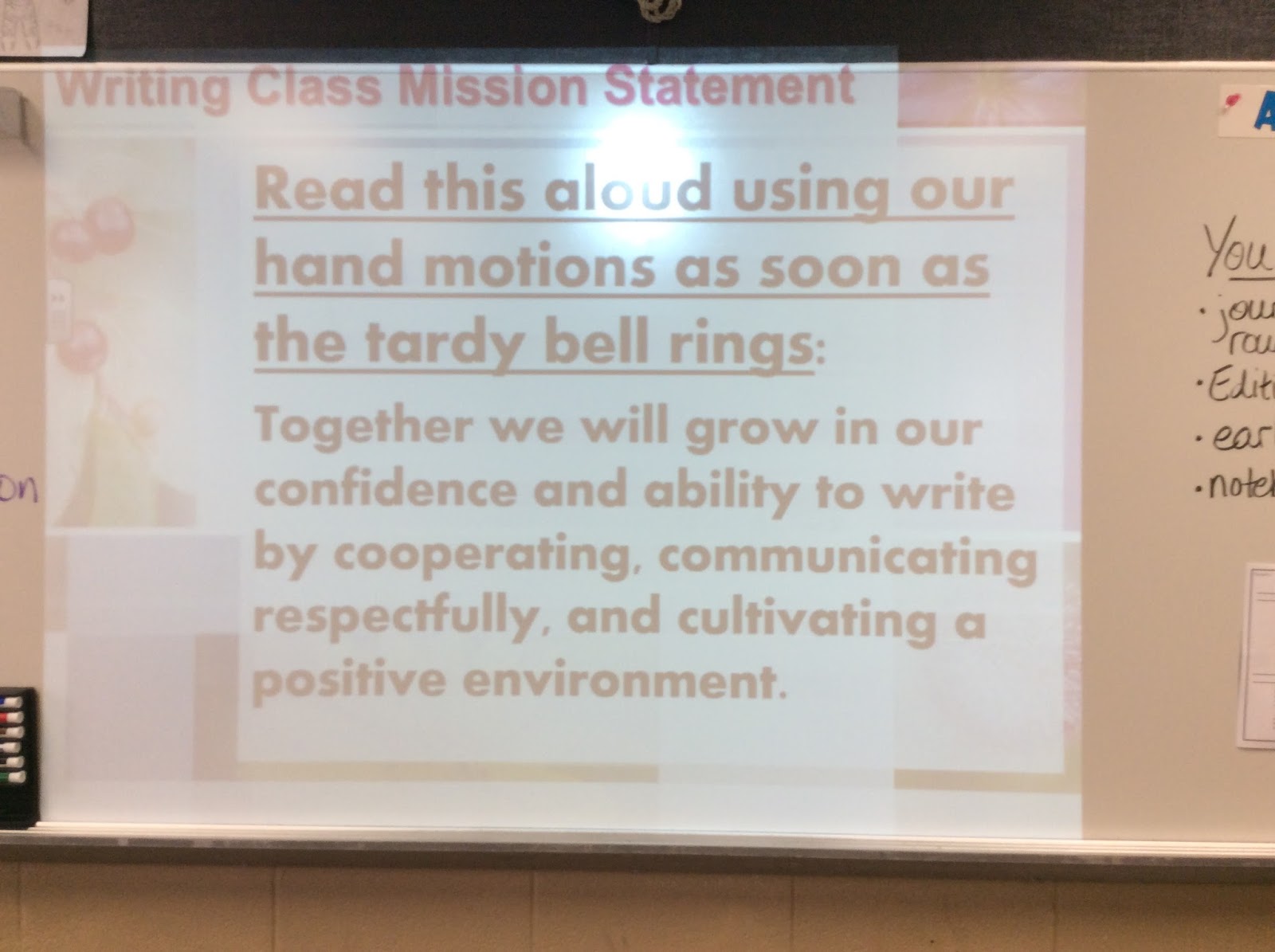
Both teachers and students have embraced this process, drafting and revising missions, pledging their commitment with a signature, and revisiting the mission at the start of each class or PLC.  Some classes have even taken it a step farther, using TPR (Total Physical Response) to attach active meaning to the words of their mission.  TPR is a brain-based learning strategy that will help these students really connect to their goals in each class.  You can watch students in Mrs. Hutson's 7th Grade ELA and Mrs. Grosenbach's ELAR classes using gestures in the videos below, and read some examples of the hard work done these first few weeks of school.

Classroom Mission Statements

Students collaborated to develop their class mission statements across the campus.

Mrs. Hutson's Class Mission Statement
Watch students recite their class mission below.


Mrs. Grosenbach's Class Mission Statement
Watch students recite their mission statement below.


Department Mission Statements

Wondering what the department mission statements are?  Here you go.


Reminder - all classes should have mission statements posted ASAP, if not already.  Also, developing a mission statements with your classes is only a first step. These must be revisited throughout the year, used as a touchstone to guide decision-making, to truly impact student learning. More to come on this as the year progresses!


Falcon Focus: Band Weekly Webinars

As I was scrolling through my Twitter feed a couple of weeks ago, I stumbled upon a retweet by @tersadavis.


Ummm...this is so cool!  What a fantastic (and entertaining) way to share expectations and information with students and families.  Mr. Lewis and Mrs. Serrano used iMovie as their video tool, and plan to continue posting webinars each Friday evening.  The videos even have special effects!


Follow the antics of Mr. Lewis and Mrs. Serrano on Twitter @NRichlandBand and be sure to subscribe to their YouTube channel for band updates.

If have any questions or would like some help implementing these or other strategies, please let me know.  And remember...


It's a great day to be a Falcon!

Wednesday, August 24, 2016

Monday, August 22

Today's Content:
  • Building Culture:  The Falcon Way
  • Continuous Improvement:  Mission Statement Collaboration
  • #CelebrateMonday: On a personal note

Falcon Focus: Falcon Way

Welcome back, NRMS! After a summer of careful reflection, challenging conversations, and lots of hard work, our teachers and staff have built an amazing culture building program!

For many of us, driving our attendance zone last Monday was an eye-opening experience about the distances that some of our students have to travel, and the social and economic disparity between many of our students. It is essential that NRMS becomes a place to be, not just a place to go.  

Through Falcon Time, students will have the opportunity to bridge that gap.  Students will build school pride, work collaboratively on real issues, learn about and practice citizenship, and reach out to our community, making this a better place to be.


So far, so good.  We've studied the data, we've got a goal, and we've laid out a plan.  However, the newness will soon wear off and we'll get into the 6-week grind.  As you move into your day-to-day routine, make time to think back on the foundation that we are laying and the kind of school we truly want to build.  And if you haven't yet submitted your feedback on Monday's Student Orientation, please take a few moments to do so now; your thoughts will help shape Day 1 for 2017.  Click here to take the survey.


Falcon Focus: Continuous Improvement

As BISD revisits and realigns Continuous Improvement across the district, Thursday's professional development was spent laying the groundwork for improvement at NRMS. Our first CI milestone is the creation of mission statements throughout our campus.  After evaluating expectations and analyzing campus data, we got to the "why".  Why continuous improvement?  And why mission statements?


  • Question 1:  Let’s talk about the why…Why should we go through this with our colleagues?  How will you do it?
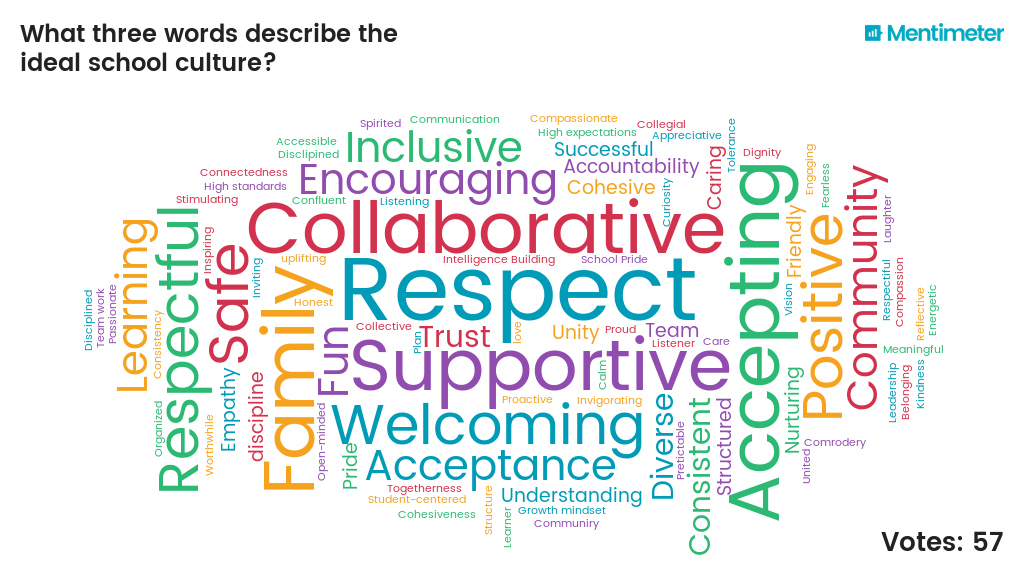
  • Question 2:  What are your beliefs about students, learning and school community?
  • Question 3:  What behaviors will you need to model and see in your colleagues  in order to represent your beliefs?
  • Question 4:  What did you hear?  Summarize what your groups have talked about.  What beliefs did you decide were most important?


Ultimately, the reason CI matters is that it ensures that all of our students have opportunities for growth.  It gives students ownership over their own learning, teaches students to advocate for themselves, and prevents any students from slipping through the cracks, whether they are our more struggling learners or most gifted innovators.

As you develop mission statements with your classes, please reflect on the sense of purpose that we need to foster in our students to help them be the best learners they can be.  They are all here to learn, and they all deserve an equal opportunity to do so.


Falcon Focus: Personal Note

As this first week gets moving, I just want to say that I am truly honored and humbled to be working alongside you. The dedication and passion for students that everyone showed last week as we unveiled Falcon Way plans was truly inspiring.  I literally had to lean over to Ann and say, "I think we're doing something really good here."  You are all doing something really good here.  Yesterday, you were my reason to #CelebrateMonday.  Thank you for that.


If have any questions or would like some help implementing these or other strategies, please let me know.  And remember...


It's a great day to be a Falcon!

ThingLink: Portrait of a Graduate