Showing posts with label STEM. Show all posts

Monday, October 1, 2018

Monday, October 1, 2018

Today's Content:
  • STEM: Problem-Based Learning
  • Rigorous & Relevant Instruction: Unpacking the TEKs
  • BOLD Literacy: Book Talk - Scythe by Neal Shusterman
The second six weeks has officially arrived, bringing with it fall decorations, lots of rain, and continued learning and instruction here at NRMS.  Check out some of the great things happening and maybe even find a few ideas for yourself and your classes.

Falcon Focus: Problem-Based Learning in the STEM Classroom 
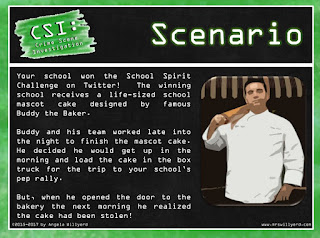
One key area of focus for STEM (Science - Technology - Engineering - Math) is the Problem-Based Learning model.  During the first six weeks, 7th grade science students tackled a PBL that challenged the students to learn about physical and chemical changes by solving a mystery. (6.5D I can identify the formation of a new substance by using the evidence of a possible chemical change such as production of a gas, change in temperature, production of a precipitate, or color change.
7.6B I can distinguish between physical and chemical changes)
The entry documents for this PBL

The "problem" for the 7th graders? A giant cake had gone missing, and it was up to the students to utilize their knowledge and observations of physical and chemical changes to identify the "mysterious white substance" and correctly match it with a suspect.

Students made predictions and recorded their observations as they tested the various powders, leading up to a final analysis of their results to identify the culprit.  
STEM learning challenges students to make predictions in order to pull them into the learning process.
Students carefully test the samples to try to determine their identities and match them to the crime scene "evidence".


 Falcon Focus: Unpacking the TEKs 

Robin Asaff leads her students in unpacking the TEKs.
Our Texas Essential Knowledge and Skills, or TEKs, guide us in planning at the right rigor and relevance levels for our students' learning; but did you realize that our standards can also be a foundational learning tool for your students?  

It's important for our students to process what they're learning and to develop their metacognative skills (thinking about their thinking).  Explicitly unpacking the TEKs does this by making the content and skills relevant to them.  "The state of Texas says we have to learn this - so what does that really mean?"  By closely examining the TEKs with our students, we are able to point out essential academic vocabulary.  Our discussions can be turned into valuable anchor charts and elements of a word wall. 
Students create a similar TEK dissection in their journals, where they can individualize their notations to deepen their understanding. 

7th grade math will use this guide to support students in their upcoming PBL.

For additional information and examples, check out the resources below.

Falcon Focus: Book Talk - Scythe by Neal Shusterman 

Finally, time for your regularly scheduled book talk.  This one is brought to you by Kathy Harvell.  

Scythe is the first novel in a series by Neal Shusterman.  It is also on the Texas Star Reading List.  It may be your new favorite book!  

Hear from Kathy below.


If have any questions or would like some help implementing these or other strategies, please let me know.  And remember...


It's a great day to be a Falcon!

Monday, October 23, 2017

Monday, October 23

Today's Content:
  • STEM: Problem-Based Learning
  • STEM: The Engingeering Design Process
  • Continuous Improvement: Implementing PDSA - a Review
We know we're a STEM campus.  We know that our math and science colleagues worked diligently last year to learn a large amount of coursework, complete several observations, and run-through various instructional trials.  We know science - technology - engineering - math.  But have you had a chance to see what STEM truly means for our students?

This Falcon Focus is dedicated to illustrating the different ways we are a growing STEM campus, and to hopefully spark some cross-curricular ideas for the future.

Inquiry, one of the main pillars of STEM education, encourages students to have voice and choice in their own learning of content, learning method, and/or product.  By capitalizing on the natural curiosity of students, inquiry creates the intrinsic motivation that fuels student learning.  Need an example?  In Kelly DeLeon's class, students needed to learn about different rock properties, so they designed their own property tests. Check out the video below...


OK, so technically the student has his vocabulary mixed up; "malleable" means that it bends, not that it breaks.  However, that was an easy fix.  His explanation and demonstration indicates deep learning, the goal of STEM education.

This exploratory learning method is quite opposite of the traditional instructional model (where students "sit and get"), so to foster this inquiry-driven environment, there are three main components:
  • Domain 1: Creating an Environment for Learning
  • Domain 2: Building Scientific Understanding
  • Domain 3: Engaging Students in Science and Engineering Practices
So what does that mean for our students? What kinds of things will our students be talking about?


Falcon Focus: Problem-Based Learning (PBL)


In Problem Based Learning, students are presented an authentic problem to solve via an entry event that includes a guiding question.  Students conduct a needs assessment, recording on a chart what they know about the problem, and what they need to learn in order to solve their problem.  In order to solve their guiding question, students have several different workshops, where they learn the necessary information and skills to solve their problem.  So, the guiding question drives the learning.

7th Grade Math recently started a problem-based learning unit on personal finance.  The entry event?  Students fast-forwarded 10 years into the future to 2027 and their hypothetical graduation from Falcon University.  Upon receiving their diplomas, each student learned about their degree, decided upon an appropriate career, and set about making financial plans for their lives.

To answer their guiding question, “Based on the current financial trends, how can I create a financial portfolio that will allow me to be a financially responsible citizen?”, students have received their first paycheck--and their first deductions.  (They are shocked by how much money comes out of paychecks.  Ha ha!)  They've also learned about net and gross pay, used various percent applications, and created family budgets.  


As students continue through the PBL, Five Star Ford will be visiting to educate students on purchasing their first vehicle.

For their final presentation, students will be creating a PSA on how to be a financially responsible citizen. Be sure to ask the 7th graders about their new lives as "adults"!


Falcon Focus: The Engineering Design Process (EDP)

Often Problem Based Learning includes engineering an actual solution to the problem.  In 6th grade science, students have used the Engineering Design Process (EDP) to design and build toy prototypes.

In their entry document (see the image to the right), students were challenged to design a toy demonstrating motion and multiple energy transformations.  The finished prototypes will be tested by their target audience, Sally Frye's awesome 3rd grade classes at Snow Heights Elementary.  Those students will determine which toys are the "best".

To get started, students explored different toys that demonstrated motion and energy transformations.  They used their science journals to sketch and record observations about the various toys.  Naturally, this led to discussion about the types of toys they might want to create themselves. Watch the videos below to see how the exploration went.


Students then set to work, learning all about motion and energy transformations in workshops that would enable them to design and build a toy that demonstrated all of required concepts.

Students are now in the production phase.  They are using recycled materials for toy parts, as well as
bringing some items from home.  Many teams have also utilized our 3D printer to create parts for their designs.  Most importantly, students are having deep conversations about their learning, as they problem-solve and work on solutions.

Later this week, they will be creating video presentations that explain the concepts demonstrated in their toys, and it will all go to Snow Heights.  Students have thoughtfully considered their 8 to 9 year old audience, tapping into their resourceful creativity.


Be looking for their prototypes to show up in the display cases sometime after Thanksgiving, once they've been returned from Snow Heights.


Falcon Focus: Implementing PDSA - a Review

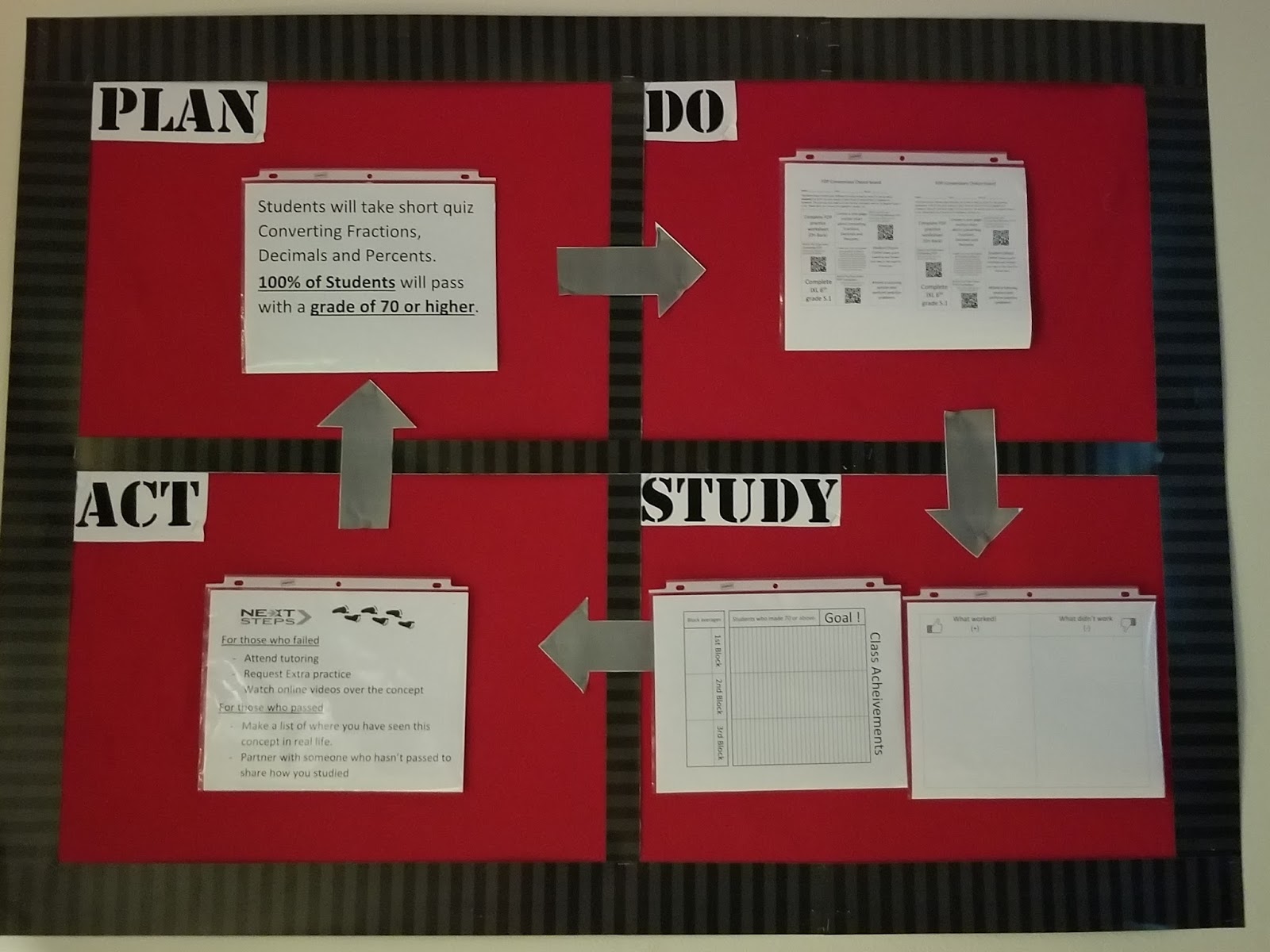
Hopefully you have your Plan-Do-Study-Act system in place in your classroom.  But in case you don't, or if you're in need of a refresher, here are the resources that we used last year to get started.
PDSA in Jonie Dodson's Class

PDSA in Josue Martinez's Class

By clicking here or on the picture below, you can access our PDSA Smore.  The Smore will walk you through how to set up (or tighten up) the PDSA process in your classroom.  It includes specific instructions to get started, tips to keep it simple, and example pictures and video.

 Link to the PDSA Smore

If you'd like to view some campus examples, you will want to visit my blog entry from March 2017.  To visit that post, click here or on the picture below.


Finally, to view the original Leaders of Learners PDSA presentation from last January, click here or on the image below.  That presentations includes district rationale and even more examples.


If have any questions or would like some help implementing these or other strategies, please let me know.  And remember...

It's a great day to be a Falcon!

Monday, May 16, 2016

Monday, May 16

Today's Content:
  • Project-Based Learning:  Room Design
  •  Digital Learning:  Social Studies Twitter Chats
  • Shifting Culture: Falcon Way Update

Falcon Focus: Project-Based Learning

Students search online to build cost estimates

Some students chose online design programs
Over the last couple of  weeks, 8th grade math has been using project-based learning to give students a chance to dream up some ideas for the new building.  Mrs. Atkinson posed the question to 8th graders, "What would you like to see included?"  The result has been an array of creative and inventive ideas to enhance our new campus.  While some concepts are more feasible than others, there's no reason not to consider at least pieces of some of their  ideas and appreciate the creativity that went into the process.

Once students selected an element to design (a "chill-out' or break room, indoor athletic facility, or outdoor recreation area), students were asked to establish the square footage of the space and its components.  Some students elected to use online design programs (see above), while others stuck with pencil and paper.  Students also researched online for cost estimates of the different design elements (see above).
   
Click on the image to see Mrs. A's Prezi
Some groups had time to start working with Tinkercad after creating their 2-D model.
See their 3-D file below.
For final products, students created either 2-D or 3-D models of their space, and presented on the total square footage, estimated cost, and overall "coolness" of their designs.  Watch the video below for a presentation over the addition of an indoor futbol field.


Tinkercad 3-D version of the above group's plan
A final extension Leslie is exploring is the use Tinkercad, an online 3-D design platform, to bring an element of authenticity to the project.  This would allow students the opportunity to see how the design process might work in the real world, by bringing smaller design elements to life with a 3-D printer.  Hopefully this piece works out; but even if it doesn't right now, you can expect to see this project even more developed in the future. 


Falcon Focus: Social Studies Twitter Chat

Teachers exhibited a lot of effort and creativity as they planned out STAAR review activities this spring.  Every room you looked in, students were moving, collaborating, discussing, and self-checking; as well as  Kahoot-ing, Quizizz-ing, Quizlet-ing, and utilizing countless other innovative digital learning tools.  One different technology approach that you may not have considered, however, is Twitter.  As part of their review, 8th grade social studies gave students the option to participate in a 3-week Twitter chat series.  Topics started with early exploration and colonization the first week, and ended with reconstruction and a call for any last questions the last week.  Students had the opportunity to answer teacher-generated questions, to read other students' responses, to respond to other students, and to ask their own questions.  Below is an excerpt of one of the chats.


If you're wondering how the a conversation flows on Twitter, you can view the entire chat transcripts on Storify.  Click on any of the three images below.  


Falcon Focus: Falcon Way Update

In the Falcon Way meetings on May 11 and 12, both students and teachers were asked what one thing they would like to see happen to build a community of CORE values from day one.  The most common responses are listed below.  Do you notice any similarities or differences?


If have any questions or would like some help implementing these or other strategies, please let me know.  And remember...

It's a great day to be a Falcon!

ThingLink: Portrait of a Graduate