Showing posts with label digital learning. Show all posts

Wednesday, March 1, 2017

Wednesday, March 1

Today's Content:
  • Questioning Strategies:  Socratic Seminar in Math
  • Literacy Focus: Authentic Reading Opportunities in 6th Grade
  • Continuous Improvement: PDSA Examples in Classrooms
Hard to believe it's already March.  This Spring semester has brought about many new strategies and creative learning opportunities for our students.

Falcon Focus: Socratic Seminar in Math


If you have never tried Socratic Seminar in your class, you should.  This student led academic discussion strategy gives students a voice by teaching them to question the world around them, clarify their opinions, support ideas with evidence, and disagree respectfully.   Basically, it makes them think - on their own.  I loved using this strategy in my ELAR class...but Math?  Who does that?

Well, Elizabeth Pauley did, with all of her math classes at the beginning of the Spring semester.  First, the students read various articles about growth mindset in math and the role of failure in learning. Different students had different articles, and practiced close reading strategies to help them process their reading. Then on day 2, they shared their thoughts on trying and failing in math, school, and life in general.  Their conversation covered the topics of growth mindset, perseverance, and how to get help from your teachers. 

Their conversation was deep and meaningful.  Please take a few minutes (four) to watch the video from their discussion.  It was an amazing and authentic discussion by some students who were really changing their viewpoints on some things.  Enjoy.


Falcon Focus: Reading Fun in 6th Grade

6th grade reading has been busy exposing students to new titles and connecting them to published authors.   On Valentine's Day, students had the opportunity to "speed date"...books!  Kathy Harvell and Kylie Norrell transformed the hallway into a reading cafe.  Students visited each table for a limited amount of time and were able to browse different genres to find books they wanted to read.  As the bell rang, I overheard at one table, "Aw, I wanted to keep reading!"  #TeacherWin


If falling in love with a book wasn't exciting enough, the 6th graders celebrated #WorldReadAloudDay on February 16 by connecting with published authors.  Throughout the day, Reading classes Skyped with authors, as they read aloud from one of their books, shared their own favorite reads, and answered student questions.  The authors who "visited" were:

Brooks Benjamin, My Seventh Grade Life in Tights
Sarah Aronson, Beyond Lucky
Janet Summer Johnson, The Last Great Adventure of the PB&J Society
Lee Gjertsen Malone, The Last Boy at St. Edith's
Miriam Spitzer Franklin, Extraordinary
Corey Ann Haydu, Rules for Stealing Stars

Hear about this experience from the students themselves by visiting the Facebook Live broadcast from Karen Teeters & Rashel Larson on #DigitalLearningDay, and check out the pictures below.


Falcon Focus: PDSA Examples in Classrooms

February has drawn to a close, and we already have so many different examples of PDSA.

Need some inspiration?  Use your spring semester Falcon Walk to learn about how a colleague is utilizing PDSA in their class.  Ask your friendly neighborhood coach for some assistance in brainstorming ideas.  Or you can just check out just a few of the campus examples below.

The "study" section includes both the assessment data and the plus/deltas from the students.

This PDSA board offers some ideas for improvement to be used in the "Do" section.


Not enough space?  Use your cabinets!

Or your white board space.  You can revise your PDSA with the simple eraser.

You may have seen this one before, but notice the Tic Tac Toe board under "Do".  Students choose how they are going to support their own learning by making a tic-tac-toe.  See a sample Tic-Tac-Toe below.


The "Do" here includes both student and teacher actions.  This way, when it's time to "Study" there is much to discuss as far as what worked and what didn't.

Since I first pulled these pictures a week ago, there are already so many more fantastic examples of PDSA being posted in classrooms and used to steer learning.  I will continue to gather ideas for you and share them with the campus.  There is a lot going on right now, and I am happy to support you however I can.  You are all doing an amazing job.  Thank you!

If have any questions or would like some help implementing these or other strategies, please let me know.  And remember...


It's a great day to be a Falcon!

Wednesday, January 4, 2017

Wednesday, January 4

Today's Content:
  • Instructional Strategies for ELLs:  Z Charts and Canva
  • Special Education: Teacher Swap in Co-Teaching
  • Falcon Way: #WheelchairChallenge and Other Empathy Building

Happy New Year!  And what a year it's been so far! Has this semester flown by as quickly for you as

it has for me?  With Falcon Way and the many other systems we have built up for our students and our campus, it has been a whirlwind.  Many have dedicated their time and effort (did I mention time? and effort?) to make a difference for our kids, and there are countless stories of the changes that are taking root.  I can’t possibly do you all the justice you deserve in my (incredibly overdue) blog post, so I’m just going to hit three of the areas where a lot of work has already made a difference.


Falcon Focus: Instructional Strategies for ELLs

The SIOP team has been hard at work this year identifying and putting into practice several different strategies specifically designed to improve the learning of our ELL students.  Most recently, the team has worked on Z Charts as key strategy.  Several teachers have already used these graphic organizers in all classes to facilitate the reading, listening, speaking, and writing of our students, with a lot of success!   

The best part about SIOP strategies is that they represent best practice for all of our students, providing opportunities discussion, collaboration, and differentiation.   

Most recently, SIOP members used Z Charts themselves to jigsaw the six key SIOP instructional features using Canva (as taught by Rashel Larson last week), Google Slides, and Power Point.  The six key features include:

·       Content Objectives
·       Language Objective
·       Age-Appropriate & Educationally Appropriate Content Concepts
·      Clear and Meaningful Supplementary Materials
·       Adaptation of Content to Student Proficiency Levels
·       Meaningful Activities That Integrate Language Practice


Click on the Prezi below to learn about the six key SIOP Instructional Features and check out the professional Canva graphics created by our teachers.  


If you have any questions about how these features would work in your own classroom, please ask Regina Walker or Mary Terry.


Falcon Focus: Taking Risks in Co-Teaching

Many of our teachers have been working hard is in our co-teach classrooms this semester as well.  Even though our we do not have the ideal co-teach structure in place, the cohort's goal is to create the best possible co-teach environment for our students.  Through our Google classroom, co-teachers are learning more about the six co-teach models and collaborating with their co-teacher on ways to make the models work for them.  A few teams have worked as target teams, opening themselves up to trying different co-teach models in less-than-ideal situations – and making it work like gangbusters!  I’m very excited about the conversations going on in our Google classroom and the resulting learning in classrooms. 

This past week, two of our teachers took it a step farther by doing a teacher swap.  Yes, you read correctly – a teacher swap. 

What's a teacher swap, you ask?  Well, in this case, it was Jonie Dodson and Teresa Davis trading places to gain a better understanding of the expectations facing the other teacher.  With the hope of establishing a clearer path to co-teach collaboration, Mrs. Dodson and Mrs. Davis took a risk and gave up control of their schedules for the day.  In the video below, check out the hard work being accomplished in Ms. Dodson's class, with Mrs. Davis at the helm:


Both teachers appreciated having the opportunity to truly see what some of the constraints are, and gained some perspective.  According to Mrs. Davis, "To step into Jonie's shoes for a day, I realize what she's been telling me...and what most of my other co-teachers tell me...that the co-teach class functions and performs much differently than the other classes, even though it is the same lesson.  So for them, in a very real way, the co-teach class is the first time they've taught that lesson each day."

Building empathy for the others in our building is the first step to true collaboration, and we are well on our way.


Falcon Focus: #WheelchairChallenge

Speaking of empathy, hats off to Sarah Peltier and the Acceptance House for the creation of the #WheelchairChallenge.  We had 9 volunteers so far, and all have told of sore arms, unexpected challenges, and surprise (occasionally overextended) kindness.  


As we continue our work to build the Falcon Way, I hope you've found the challenges to be rewarding and look forward to many more celebrations in the new year!  Enjoy some of the celebrations from the the fall semester in the video below.  (Spoiler alert: There's a video of Mr. V participating in the #WheelchairChallenge towards the end!)


If have any questions or would like some help implementing these or other strategies, please let me know.  And remember...


It's a great day to be a Falcon!
Wednesday, October 26, 2016

Tuesday, October 25

Today's Content:
  • Tier 1 Priorities:  Primary Sources
  • Tier 1 Priorities: Close Reading
  • Special Education: Co-Teach Cohort

Falcon Focus: Primary Sources

Primary sources continue to be a focal point of instruction in Social Studies.  But between complex content, dated language, and (gasp) cursive handwriting, primary sources can pose an especially challenging read for our students.

So how do we make that historical, necessary content more accessible to students?  One way is to make the learning authentic--to find a way to help the students empathize with the author, subject, or content within the piece itself.

Recently, 8th grade American History investigated the Boston Massacre crime scene.  Students had the opportunity to play detective by analyzing historical artwork depicting the event; observing the crime scene itself, complete with "blood" and "clues";  and reading first-hand accounts from individuals present at the Massacre.

Students work in groups to analyze the crime scene of the Boston Massacre
If it seems like to much information for students to process, it's not.  Different crime scene elements were broken out into stations, and each station provided scaffolds to help with content comprehension.  The written documents had been reenacted and performed for students to listen to or watch while or after reading the original document.  Both the artwork and the crime scene were paired with guiding questions to help students navigate the different types of information being shared.  And all throughout, students had access to each other as they grappled with the different perspectives of the Boston Massacre.

Students use guiding questions to analyze visual primary sources

To help students with comprehension of the difficult language, teachers "performed" each monologue.

In 7th grade Texas History, students have also recently used primary sources, as they are learning about Stephen F. Austin's colonization into Spanish Texas.  In small groups or partners, students read several different letters that had been written to request a spot in Austin's new colony.  Then, students evaluated each individual against a set of criteria to determine whether or not they were a good "fit". The primary source letters presented challenging language and unfamiliar context.  So what helped these students make meaning from the text?

First, the amount of the text is manageable.  Each letter written to Stephen F. Austin fit nicely on a half-page, so students could grapple with the text without getting burned out on the difficulty.

Students grappling with primary sources
More grappling
Evaluating each colony candidate against criteria


In addition, students had the opportunity to read these aloud.  For our auditory learners, hearing the reading will help them process the information; plus, we get to hear students try on some really fantastic accents!  The student below is reading from except A above, "Buffalo" Jones.


Falcon Focus: Close Reading

You may have heard this before, but we are all teachers of reading.   Close reading is main pillar of ELAR instruction, and different variations of it can and should be used in any content area.

When students close read, the goal is for students to go back into a text and use text evidence to support their response to a very targeted question.  The success of the close reading activity relies heavily on the question.  In ELAR, there are 4 specific question levels:

1) What does the text say?  (comprehension)
2) What does the text mean? (making inferences/drawing conclusions)
3) How does the text work? (author's craft)
4) What does the text inspire you to do? (writing piece or other response)

After attending the content professional learning days, 6th grade Reading tried out a strategy called "SpongeBeyonceBananaPants".  (Yes, that's the actual name of this strategy.  No, it has no meaning to the activity other than students remember it. No, Kathy and Kylie did not make it up.)  In this strategy, students use a graphic organizer interact with the text, which in this case, is a poem.

Teacher designed questions require students to go back into the text multiple times to support their responses.


In Sherry Grosenbach's class, students used specific plastic flags to interact with the text in a different way.  In addition to writing on the passage (in this case, a speech), students used the flags to identify different elements of the speech in a hands-on way.  Then when it was time for deeper analysis, students used their tactile practice with the text to move back through it more efficiently.
Close reading can be tactile, too!
If you don't have fancy flags, simply substitute sticky notes or paper clips.  In the future, we will be talking more about how different close reading strategies can help support students in your content areas, as well.  Stay tuned!


Falcon Focus: Co-teaching Cohort

This year all of our teachers with a co-teach classroom (both general ed and special ed) are participating in a flipped year-round cohort.  While we know there are limitations to our schedule, we also believe that we can do better for our students.  Therefore, our goal is to improve our co-teach practice by finding ways to creatively implement co-teach best practices.

Throughout the year, we will be reviewing the six co-teach models: one teach, one observe; station teaching; parallel teaching; alternative teaching; teaming; and one teach, one assist.  The bulk of the work is happening in Google Classroom, with some observation and coaching time for some.

Don't have a special education co-teach classroom, but still want to learn more?  You are welcome to participate in the Google classroom with us; just email me and I will get you more information.


If have any questions or would like some help implementing these or other strategies, please let me know.  And remember...


It's a great day to be a Falcon!

Monday, May 16, 2016

Monday, May 16

Today's Content:
  • Project-Based Learning:  Room Design
  •  Digital Learning:  Social Studies Twitter Chats
  • Shifting Culture: Falcon Way Update

Falcon Focus: Project-Based Learning

Students search online to build cost estimates

Some students chose online design programs
Over the last couple of  weeks, 8th grade math has been using project-based learning to give students a chance to dream up some ideas for the new building.  Mrs. Atkinson posed the question to 8th graders, "What would you like to see included?"  The result has been an array of creative and inventive ideas to enhance our new campus.  While some concepts are more feasible than others, there's no reason not to consider at least pieces of some of their  ideas and appreciate the creativity that went into the process.

Once students selected an element to design (a "chill-out' or break room, indoor athletic facility, or outdoor recreation area), students were asked to establish the square footage of the space and its components.  Some students elected to use online design programs (see above), while others stuck with pencil and paper.  Students also researched online for cost estimates of the different design elements (see above).
   
Click on the image to see Mrs. A's Prezi
Some groups had time to start working with Tinkercad after creating their 2-D model.
See their 3-D file below.
For final products, students created either 2-D or 3-D models of their space, and presented on the total square footage, estimated cost, and overall "coolness" of their designs.  Watch the video below for a presentation over the addition of an indoor futbol field.


Tinkercad 3-D version of the above group's plan
A final extension Leslie is exploring is the use Tinkercad, an online 3-D design platform, to bring an element of authenticity to the project.  This would allow students the opportunity to see how the design process might work in the real world, by bringing smaller design elements to life with a 3-D printer.  Hopefully this piece works out; but even if it doesn't right now, you can expect to see this project even more developed in the future. 


Falcon Focus: Social Studies Twitter Chat

Teachers exhibited a lot of effort and creativity as they planned out STAAR review activities this spring.  Every room you looked in, students were moving, collaborating, discussing, and self-checking; as well as  Kahoot-ing, Quizizz-ing, Quizlet-ing, and utilizing countless other innovative digital learning tools.  One different technology approach that you may not have considered, however, is Twitter.  As part of their review, 8th grade social studies gave students the option to participate in a 3-week Twitter chat series.  Topics started with early exploration and colonization the first week, and ended with reconstruction and a call for any last questions the last week.  Students had the opportunity to answer teacher-generated questions, to read other students' responses, to respond to other students, and to ask their own questions.  Below is an excerpt of one of the chats.


If you're wondering how the a conversation flows on Twitter, you can view the entire chat transcripts on Storify.  Click on any of the three images below.  


Falcon Focus: Falcon Way Update

In the Falcon Way meetings on May 11 and 12, both students and teachers were asked what one thing they would like to see happen to build a community of CORE values from day one.  The most common responses are listed below.  Do you notice any similarities or differences?


If have any questions or would like some help implementing these or other strategies, please let me know.  And remember...

It's a great day to be a Falcon!

Monday, April 18, 2016

Monday, April 18


Today's Content:
  • Shifting Culture: Defining the Falcon Way 
  • Tier 1 Priorities:  Using Data to Drive Instruction
  • Digital Learning:  #CelebrateMonday

Falcon Focus: Defining 
The Falcon Way

As we near the end of the school year, we have only about 42 more weeks in this school.  With the new building right around the corner (ha, ha), we have a unique and significant opportunity to define and establish a united, positive campus culture rooted in learning for students, teachers, staff, admin -- and the community at large. This new culture is called The Falcon Way.

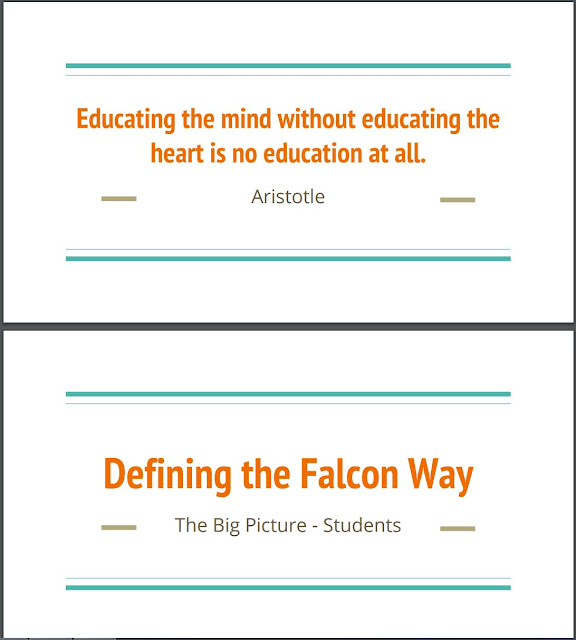
All faculty and staff are invited to help develop this new way that we are building for our students and our community.  If you missed last week's meeting, the presentation is listed below.  Basically, it covers the following topics:
  • Mindset - How are we approaching this culture shift?  How can participants contribute to the process most successfully?
  • The foundation of the project - culture change via bringing the CORE values to life = The Falcon Way
  • Vehicles of change that have been identified, including weekly advisory period and BOY orientation for all students
  • Opening the discussion to move forward 
To view the full presentation, simply click on the slides below.  Meeting discussion was recorded on Padlet (also, see below).

 The Falcon Way: 4/13/16
Click on the slides to see the PPT

Click on the image to see the Padlet

If you did not make it to the April 14th meeting, you are still welcome to attend any and all future meetings. We recognize that attending five Thursdays in a row is very difficult; just come when you can to be part of the conversation.  This Thursday, we will be discussing teacher support during our culture growth.  All upcoming meetings are listed below.

 Falcon Focus: Using Data to Drive Instruction

8th grade science is gearing up for the STAAR test, and they are using data to do it.  Last week, students took the 2015 released test.   Using "Par for the STAAR", students then analyzed their own results and identified areas of strength and weakness.

Robin Asaff and Lee Wagstaff are able to target specific TEKS in class that affect the majority of students, and kids are able to decide which reporting category-focused STAAR tutorials they should attend.  Furthermore,  Karen Sanchez is also pitching in, creating Reporting Category-specific workstations and assisting in 8th grade classes.  Thanks to this collaborative effort, students are able to guide their own STAAR instruction, and own their learning.  Our 8th graders will be well prepared this spring!

'Par for the STAAR'

Robin works with students in data analysis

Students work collaboratively to identify strengths and weaknesses

 Falcon Focus: #CelebrateMonday

Finally, each week is another opportunity to identify the greatness in our students, our classes, and our school.

Let's find those fabulous school moments and celebrate them.  Post pics and comments of the great things going on here at NRMS using #CelebrateMonday and #nrms2015 to share our awesomeness with the world!


If have any questions or would like some help implementing these or other strategies, please let me know.  And remember...

It's a great day to be a Falcon!

Saturday, April 9, 2016

Monday, April 11

Today's Content:
  • Professional Development: Falcon Learning Walks
  • Tier 1 Priorities:  Workshop Model/Chunk & Chew
  • Digital Learning:  Telling Your Story on Social Media - #LoveMySchoolDay

Falcon Focus: Falcon Learning Walks

In education, we are always striving to learn more, do more, be better teachers for our students.  But sometimes when we hear about an enlightened philosophy, a "breakthrough" strategy, or a new technology, we think, "That sure sounds good...but how would that work in my classroom?" Sometimes, we have to see something in action to really wrap our minds around it.

As a result, many teachers have asked for the opportunity to see how some of our priorities and focus areas work in the real world.  So enter the Falcon Learning Walks, our structure for informal peer observation.  As we discussed on Friday, April 1st, the purpose is to provide teachers with self-determined, collaborative professional development.  You identify the type of observation that will best help you and your students, and then make it happen.  We've outlined 4 simple steps:
  • Determine your focus - Which instructional or management areas will help you and your students the most?  Who can help you gain new perspective on this?
  • Request an observation - Check with the teacher before you visit.
  • Document your observation - Take notes and mindful of the students; how does what they're doing impact their learning?
  • Reflect - What does what you saw mean for you and your classroom?

Furthermore, we talked about our Learning Walk Protocols:
  • Intentionally plan your observations.
  • Walk in with a growth mindset.
  • Observe for a minimum of 15 minutes.
  • Remember to be an observer and not a participant in the lesson.
  • Complete the Falcon Reflection Form to let your Academic Coach know if you need any assistance.
You can also review the Learning Walk handout.


Falcon Focus: Workshop Model/Chunk & Chew

For students to truly own their learning, they need time to process the information.  Kathleen Kryza calls this the "chunk" and "chew" of learning: "For every 10 minutes you teach something new, the brain needs 1 to 2 minutes to chew."  So, new information = chunk, process time = chew.  This fits right along with the workshop model, a major component of our tier 1 priorities.

In Samantha Taylor's math classes, chunk and chew time is built into every activity.  First, she chunks the concept to be learned into smaller, more manageable bits of information.  In a probability lesson last week, Samantha introduced the concept using the "Falcon Downs" - a horse race simulation using dice.


You can see in the video below how the students transition from chunk time as a whole class (learning about many possible outcomes of the horse race) to individual chew time (the opportunity for students to process and think about that new concept).


A way to build in collaborative "chew" time is with classroom discussions.   Samantha uses strategies like Turn and Talk and Stand Up-Hand Up-Pair Up to encourage the students to "chew" on their learning with their peers, and further refine their understanding.

Stand Up - Hand Up - Pair Up


"Chewing" through Collaborative Discussion

 Because this is part of the everyday process, students expect that they will be thinking about math, writing about math, and talking about math with their peers.


Falcon Focus: Tell Your Story

Want a chance to tell the story of your classroom?  This Monday is Love My School Day - the perfect opportunity to start using social media for that very purpose.

Use your Twitter account to showcase great things going on with your students.  Be sure to use the appropriate hashtags - and there are lots!

#LoveMySchoolDay
#CelebrateMonday
#nrms2015
#bisddlp
#BISDShines

You can also follow me @maryterry2015 !


If have any questions or would like some help implementing these or other strategies, please let me know.  And remember...

It's a great day to be a Falcon!

ThingLink: Portrait of a Graduate