Showing posts with label continuous improvement. Show all posts

Tuesday, September 4, 2018

Tuesday, September 4, 2018

Today's Content:
  • BOLD Literacy: Reading, Reading Everywhere!
  • Instructional Coherency: Help With All the Things
  • Campus of Learning: #ObserveMe
Thank you so much for a great second week of learning and instruction at NRMS!  The 2018-19 school year is off to a Falcon-tastic start, and there is so much great work going on already.  Keep on reading to celebrate the hard work of your peers and students and to gain some insight into different instructional priorities.

Falcon Focus: Reading, Reading Everywhere! 


In Birdville we are very focused on Building Opportunities for Literacy Daily, and Falcons have embraced the chance to read, write, think, and discuss.  

All around campus you can catch glimpses of students' and teachers' reading lives, and listen to them sharing in a culture of literacy.  

See below for examples of reading displays, book talks, and other suggestions.


Students cozy up with a good book where ever they can.


Student book talks help students spread the word about reading.

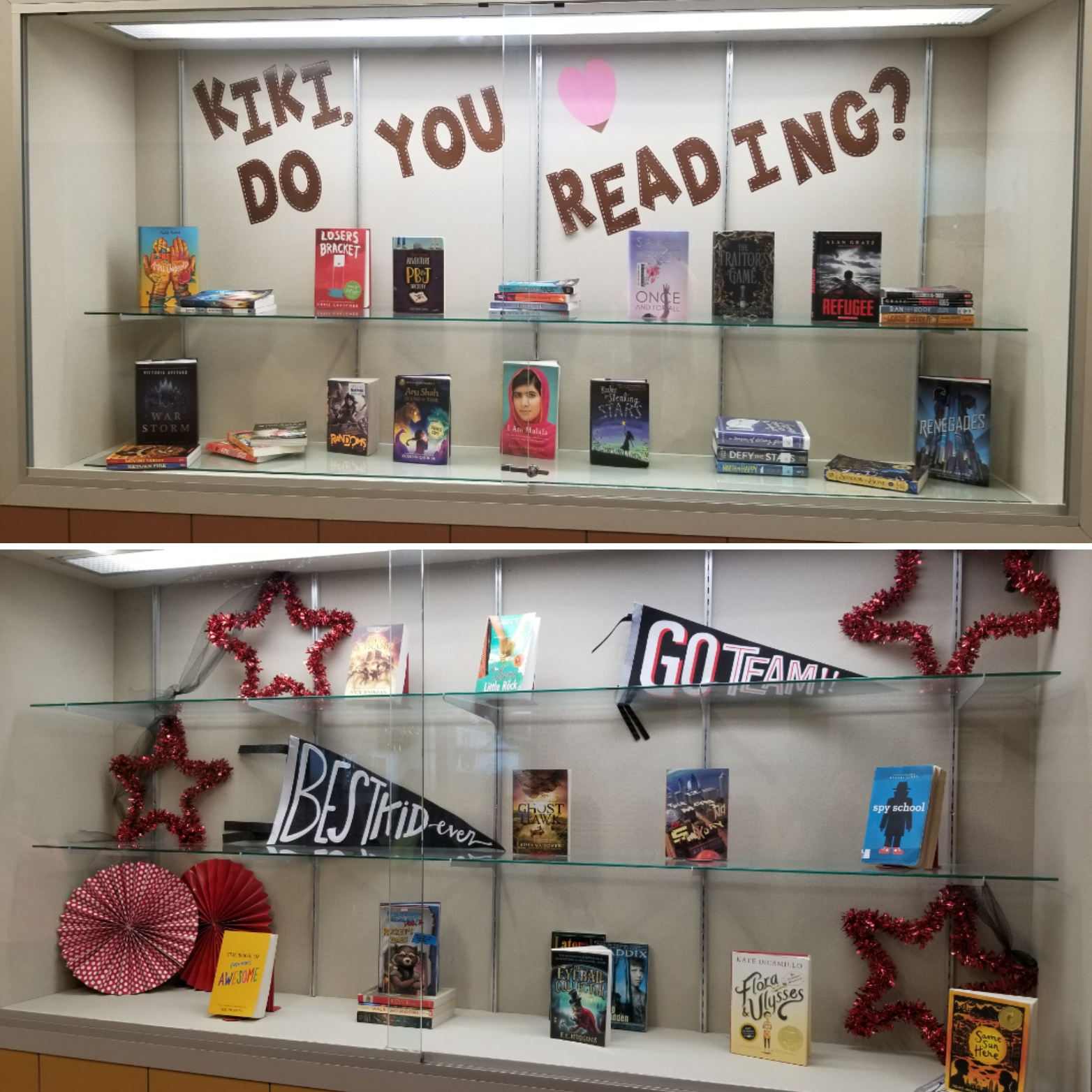
Book displays help students (and teachers) find their next great read.


Brittany Joyner invites students to share their book suggestions.  She also encourages them to read Lone Star Readers by celebrating their progress and reading alongside them.

The Lone Star Reading Program invites students to read their choice of 10 books from a list, after which they get to attend a catered luncheon with an author.  This year, the guest of honor is Jason Reynolds, author of Long Way Down and Ghost.  Want to read alongside the students as well?  Check in the library for this year's list!

Faculty and staff get into the reading fun with a variety of different texts.
Looking for a good book to read?  Below, Sherryl Dickey shares a book talk over the book she just finished, I'll Push You by Patrck Grey.

 jklj


Falcon Focus: Help With All the Things

During our back-to-school professional learning, several teachers led us through instructional campus expectations.  Extra thanks to: Robin Asaff, Lindsey Cato, Felicia Cherry, Kylie Cranford, Teresa Davis, Jonie Dodson, Beverly Goodman, Kathy Harvell, James Hollis, Lori Liles, Karen Sanchez, and Amy Thornton for their leadership and hard work.  

All the presentation materials used can be found in our NRMS Google Classroom, but I've also included a link below to the folder.  There are also a few additional resources to support you with "all the things".  Click on the red titles to get to the Google folder.


Monday, August 13 Professional Learning - In this folder you can find:
  • Falcon Culture 2018-19
  • Culture of Literacy
  • Tier 1 Priorities & Instructional Coherency
  • Literacy Strategies
  • Continuous Improvement Expectations
  • Workshop Model & 5E
  • Building Vocabulary

Thursday, August 16 Professional Learning - In this folder you can find:
  • Google Classroom for Beginners
  • Google Classroom for Experienced Teachers
  • Plan-Do-Study-Act
  • Making Your SMART Goals Smarter
  • Behavior Intervention Strategies
  • Mission Statements: Defining Purpose


Instructional Coherency Documents - This is the list of campus instructional expectations for all of our departments.  We will be developing them for Special Ed and Electives through our PLC work this year.


Continuous Improvement Google Site - This Google Site includes examples and how-tos for all of the Continuous Improvement pieces.  I will continue to update it with relevant examples from our campus.


Falcon Focus: #ObserveMe

#ObserveMe originated from the collective realization of many educators that there was an opportunity to learn from each other.  In a Twitter Chat in 2016, one teacher posted the idea of inviting other teachers into their classroom to give targeted feedback. Other educators and groups such as @Robert Kaplinsky and @Teacher2Teacher jumped on this idea and turned it into the movement that it is just two years later.

To participate, determine two to three goals that you are working on in your classroom.  Create a short Google Form that visitors can complete in order to collect your feedback.  Finally, post an invitation to others to come on in and share their observations.  

Jonie Dodson is participating in #ObserveMe this school year.  She has shared her editable #ObserveMe sign here.  She would appreciate you stopping in to share your thoughts about her classroom!

Want to read more?

Robert Kaplinsky started the #ObserveMe movement with this blog post in 2016. 


One year later, Kaplinsky wrote a post reflecting the #ObserveMe movement and different "tricks" he wish he had known at the beginning.


Jennifer Gonzalez, creator of the blog Cult of Pedagogy, wrote a piece on why we need to observe each other. 

If you decide to participate in #ObserveMe, please let me know!  I love visiting classrooms, and would enjoy offering feedback.  I will be creating my own #ObserveMe as well.  Be on the lookout for a sign on my office door!


If have any questions or would like some help implementing these or other strategies, please let me know.  And remember...

It's a great day to be a Falcon!


Monday, October 23, 2017

Monday, October 23

Today's Content:
  • STEM: Problem-Based Learning
  • STEM: The Engingeering Design Process
  • Continuous Improvement: Implementing PDSA - a Review
We know we're a STEM campus.  We know that our math and science colleagues worked diligently last year to learn a large amount of coursework, complete several observations, and run-through various instructional trials.  We know science - technology - engineering - math.  But have you had a chance to see what STEM truly means for our students?

This Falcon Focus is dedicated to illustrating the different ways we are a growing STEM campus, and to hopefully spark some cross-curricular ideas for the future.

Inquiry, one of the main pillars of STEM education, encourages students to have voice and choice in their own learning of content, learning method, and/or product.  By capitalizing on the natural curiosity of students, inquiry creates the intrinsic motivation that fuels student learning.  Need an example?  In Kelly DeLeon's class, students needed to learn about different rock properties, so they designed their own property tests. Check out the video below...


OK, so technically the student has his vocabulary mixed up; "malleable" means that it bends, not that it breaks.  However, that was an easy fix.  His explanation and demonstration indicates deep learning, the goal of STEM education.

This exploratory learning method is quite opposite of the traditional instructional model (where students "sit and get"), so to foster this inquiry-driven environment, there are three main components:
  • Domain 1: Creating an Environment for Learning
  • Domain 2: Building Scientific Understanding
  • Domain 3: Engaging Students in Science and Engineering Practices
So what does that mean for our students? What kinds of things will our students be talking about?


Falcon Focus: Problem-Based Learning (PBL)


In Problem Based Learning, students are presented an authentic problem to solve via an entry event that includes a guiding question.  Students conduct a needs assessment, recording on a chart what they know about the problem, and what they need to learn in order to solve their problem.  In order to solve their guiding question, students have several different workshops, where they learn the necessary information and skills to solve their problem.  So, the guiding question drives the learning.

7th Grade Math recently started a problem-based learning unit on personal finance.  The entry event?  Students fast-forwarded 10 years into the future to 2027 and their hypothetical graduation from Falcon University.  Upon receiving their diplomas, each student learned about their degree, decided upon an appropriate career, and set about making financial plans for their lives.

To answer their guiding question, “Based on the current financial trends, how can I create a financial portfolio that will allow me to be a financially responsible citizen?”, students have received their first paycheck--and their first deductions.  (They are shocked by how much money comes out of paychecks.  Ha ha!)  They've also learned about net and gross pay, used various percent applications, and created family budgets.  


As students continue through the PBL, Five Star Ford will be visiting to educate students on purchasing their first vehicle.

For their final presentation, students will be creating a PSA on how to be a financially responsible citizen. Be sure to ask the 7th graders about their new lives as "adults"!


Falcon Focus: The Engineering Design Process (EDP)

Often Problem Based Learning includes engineering an actual solution to the problem.  In 6th grade science, students have used the Engineering Design Process (EDP) to design and build toy prototypes.

In their entry document (see the image to the right), students were challenged to design a toy demonstrating motion and multiple energy transformations.  The finished prototypes will be tested by their target audience, Sally Frye's awesome 3rd grade classes at Snow Heights Elementary.  Those students will determine which toys are the "best".

To get started, students explored different toys that demonstrated motion and energy transformations.  They used their science journals to sketch and record observations about the various toys.  Naturally, this led to discussion about the types of toys they might want to create themselves. Watch the videos below to see how the exploration went.


Students then set to work, learning all about motion and energy transformations in workshops that would enable them to design and build a toy that demonstrated all of required concepts.

Students are now in the production phase.  They are using recycled materials for toy parts, as well as
bringing some items from home.  Many teams have also utilized our 3D printer to create parts for their designs.  Most importantly, students are having deep conversations about their learning, as they problem-solve and work on solutions.

Later this week, they will be creating video presentations that explain the concepts demonstrated in their toys, and it will all go to Snow Heights.  Students have thoughtfully considered their 8 to 9 year old audience, tapping into their resourceful creativity.


Be looking for their prototypes to show up in the display cases sometime after Thanksgiving, once they've been returned from Snow Heights.


Falcon Focus: Implementing PDSA - a Review

Hopefully you have your Plan-Do-Study-Act system in place in your classroom.  But in case you don't, or if you're in need of a refresher, here are the resources that we used last year to get started.
PDSA in Jonie Dodson's Class

PDSA in Josue Martinez's Class

By clicking here or on the picture below, you can access our PDSA Smore.  The Smore will walk you through how to set up (or tighten up) the PDSA process in your classroom.  It includes specific instructions to get started, tips to keep it simple, and example pictures and video.

 Link to the PDSA Smore

If you'd like to view some campus examples, you will want to visit my blog entry from March 2017.  To visit that post, click here or on the picture below.


Finally, to view the original Leaders of Learners PDSA presentation from last January, click here or on the image below.  That presentations includes district rationale and even more examples.


If have any questions or would like some help implementing these or other strategies, please let me know.  And remember...

It's a great day to be a Falcon!

Wednesday, August 23, 2017

Wednesday, August 23

Today's Content:
  • Continuous Improvement: Getting Started with Mission Statements
  • Falcon Welcome: Celebrating Our New Campus
Welcome back Falcons!  It has been a long time coming, but 2017-18 school year is finally here.  We have much to anticipate, and much to celebrate.  Let's get started!

Falcon Focus: Getting Started with Mission Statements


As our classes get underway, several teachers have asked for assistance with Mission Statements.  Mission Statements are critical to effective continuous improvement, so you definitely want to consider this in your first few weeks of instruction.  

Here's your Mission Statement refresher, in three easy steps.  

Step 1:  Why write a mission statement?  As a group, we must know and understand our purpose. Only with clear goals in mind can we align our attitudes and actions to achieve group success.  Putting our mission into words helps us and our students stay focused on the reason for being in our classes - to learn, of course!  Everything in your class should ALWAYS come back to your mission, and involving the students in that process helps them take ownership in their own learning.

Not to mention it is a district and school expectation, so there's that, too.   

Step 2:  How do I write a mission statement?  There are three key questions that your students and you need to consider and discuss:  1) Why are we here?  2) What do we have to do well together?  and 3) How will we make it happen?  These questions help students narrow, refine, and articulate their thinking on why we are at school in the first place, and how we can achieve the goals we set forth.

Need more guidance?  Check out this Google Slides presentation; it will walk you through the Mission Statement writing process.  Feel free to make a copy and edit as you see fit.


Example Mission Statements


Step 3: Now that we've written our mission statement, what do we do?    A mission statement should be a cornerstone of your classroom culture, a mantra.  Revisit it often.  Students (and teachers) should use it to help guide their actions rather than hinder their learning and classroom environment.  If students know it well enough, they will even use it to keep each other in check.  

Click on the links below to view two examples from last year of students interacting with their mission statements.

Mrs. Grosenbach’s ELAR Recites Mission Statement


Falcon Focus: Celebrating Our New Campus

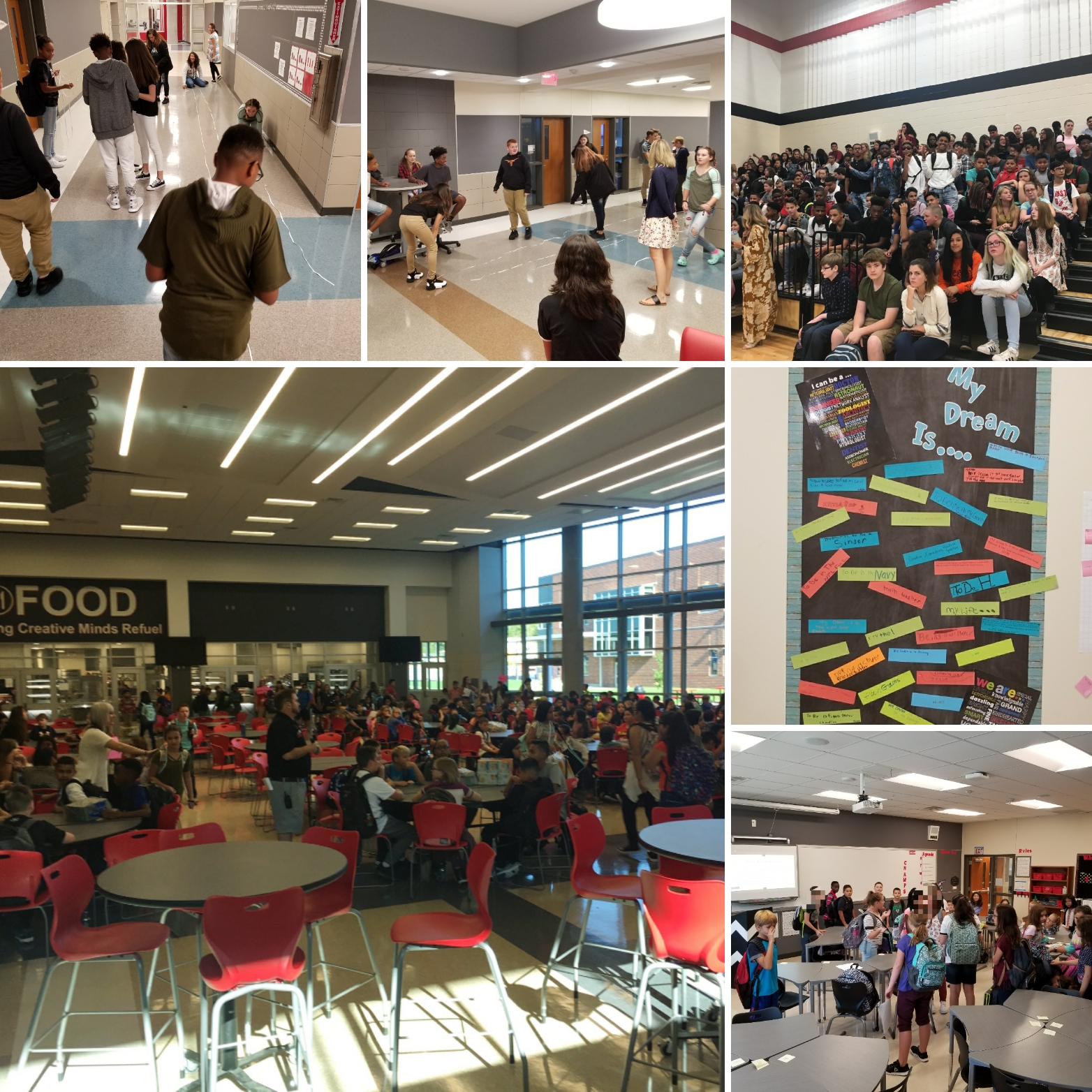
It has been an amazing start to the year!  Students are learning their way around the building, and our new space is a new beginning for everyone.  Please enjoy a few pics from the first few days, and if you have something to celebrate, share it on Twitter using #NRMSProud.  (Just be sure to check the photo permission list before posting students' pictures.)  Let's share our story with the community, and let them see the great things happening at our school.

PD Shenanigans

NRMS Ribbon Cutting
1st Day Excitement


If have any questions or would like some help implementing these or other strategies, please let me know.  And remember...

It's a great day to be a Falcon! 

Wednesday, March 1, 2017

Wednesday, March 1

Today's Content:
  • Questioning Strategies:  Socratic Seminar in Math
  • Literacy Focus: Authentic Reading Opportunities in 6th Grade
  • Continuous Improvement: PDSA Examples in Classrooms
Hard to believe it's already March.  This Spring semester has brought about many new strategies and creative learning opportunities for our students.

Falcon Focus: Socratic Seminar in Math


If you have never tried Socratic Seminar in your class, you should.  This student led academic discussion strategy gives students a voice by teaching them to question the world around them, clarify their opinions, support ideas with evidence, and disagree respectfully.   Basically, it makes them think - on their own.  I loved using this strategy in my ELAR class...but Math?  Who does that?

Well, Elizabeth Pauley did, with all of her math classes at the beginning of the Spring semester.  First, the students read various articles about growth mindset in math and the role of failure in learning. Different students had different articles, and practiced close reading strategies to help them process their reading. Then on day 2, they shared their thoughts on trying and failing in math, school, and life in general.  Their conversation covered the topics of growth mindset, perseverance, and how to get help from your teachers. 

Their conversation was deep and meaningful.  Please take a few minutes (four) to watch the video from their discussion.  It was an amazing and authentic discussion by some students who were really changing their viewpoints on some things.  Enjoy.


Falcon Focus: Reading Fun in 6th Grade

6th grade reading has been busy exposing students to new titles and connecting them to published authors.   On Valentine's Day, students had the opportunity to "speed date"...books!  Kathy Harvell and Kylie Norrell transformed the hallway into a reading cafe.  Students visited each table for a limited amount of time and were able to browse different genres to find books they wanted to read.  As the bell rang, I overheard at one table, "Aw, I wanted to keep reading!"  #TeacherWin


If falling in love with a book wasn't exciting enough, the 6th graders celebrated #WorldReadAloudDay on February 16 by connecting with published authors.  Throughout the day, Reading classes Skyped with authors, as they read aloud from one of their books, shared their own favorite reads, and answered student questions.  The authors who "visited" were:

Brooks Benjamin, My Seventh Grade Life in Tights
Sarah Aronson, Beyond Lucky
Janet Summer Johnson, The Last Great Adventure of the PB&J Society
Lee Gjertsen Malone, The Last Boy at St. Edith's
Miriam Spitzer Franklin, Extraordinary
Corey Ann Haydu, Rules for Stealing Stars

Hear about this experience from the students themselves by visiting the Facebook Live broadcast from Karen Teeters & Rashel Larson on #DigitalLearningDay, and check out the pictures below.


Falcon Focus: PDSA Examples in Classrooms

February has drawn to a close, and we already have so many different examples of PDSA.

Need some inspiration?  Use your spring semester Falcon Walk to learn about how a colleague is utilizing PDSA in their class.  Ask your friendly neighborhood coach for some assistance in brainstorming ideas.  Or you can just check out just a few of the campus examples below.

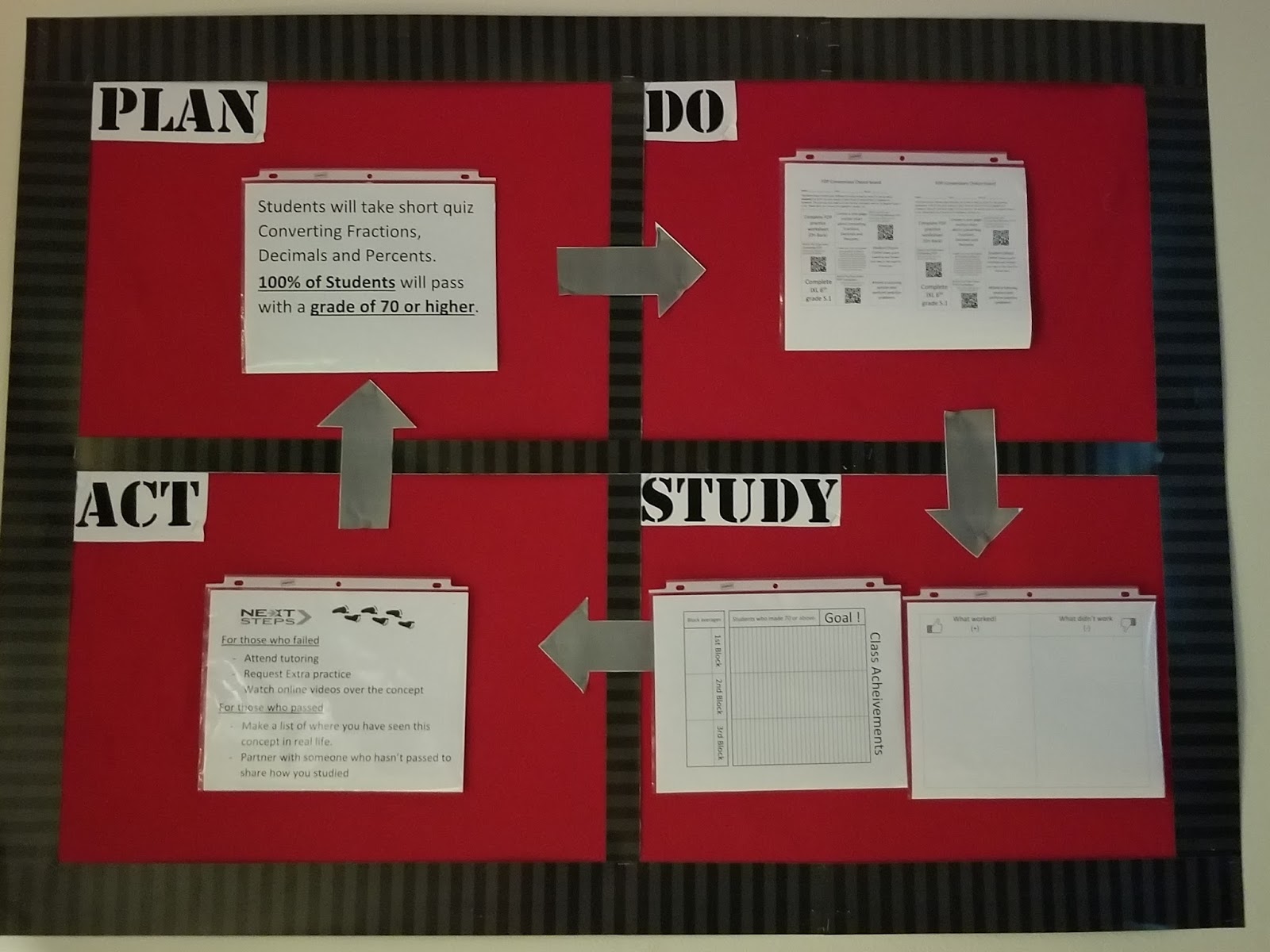
The "study" section includes both the assessment data and the plus/deltas from the students.

This PDSA board offers some ideas for improvement to be used in the "Do" section.


Not enough space?  Use your cabinets!

Or your white board space.  You can revise your PDSA with the simple eraser.

You may have seen this one before, but notice the Tic Tac Toe board under "Do".  Students choose how they are going to support their own learning by making a tic-tac-toe.  See a sample Tic-Tac-Toe below.


The "Do" here includes both student and teacher actions.  This way, when it's time to "Study" there is much to discuss as far as what worked and what didn't.

Since I first pulled these pictures a week ago, there are already so many more fantastic examples of PDSA being posted in classrooms and used to steer learning.  I will continue to gather ideas for you and share them with the campus.  There is a lot going on right now, and I am happy to support you however I can.  You are all doing an amazing job.  Thank you!

If have any questions or would like some help implementing these or other strategies, please let me know.  And remember...


It's a great day to be a Falcon!

Tuesday, September 20, 2016

Tuesday, September 20

Today's Content:
  • Continuous Improvement:  Mission Statements Schoolwide
  • Digital Communication: Band Weekly Webinars

Falcon Focus: Mission Statements Schoolwide

Over the past several weeks, Falcons have created mission statements to clarify our goals and to provide purpose to our day-to-day.  With personalized phrasing as diverse as our population, these mission statements will serve as the foundation of our work this year, both as a campus and in our classrooms.

For mission statements to work, stakeholders must have ownership in the writing process. This allows individuals to recognize the why behind the work, and creates a focal point when distractions become, well, distracting.

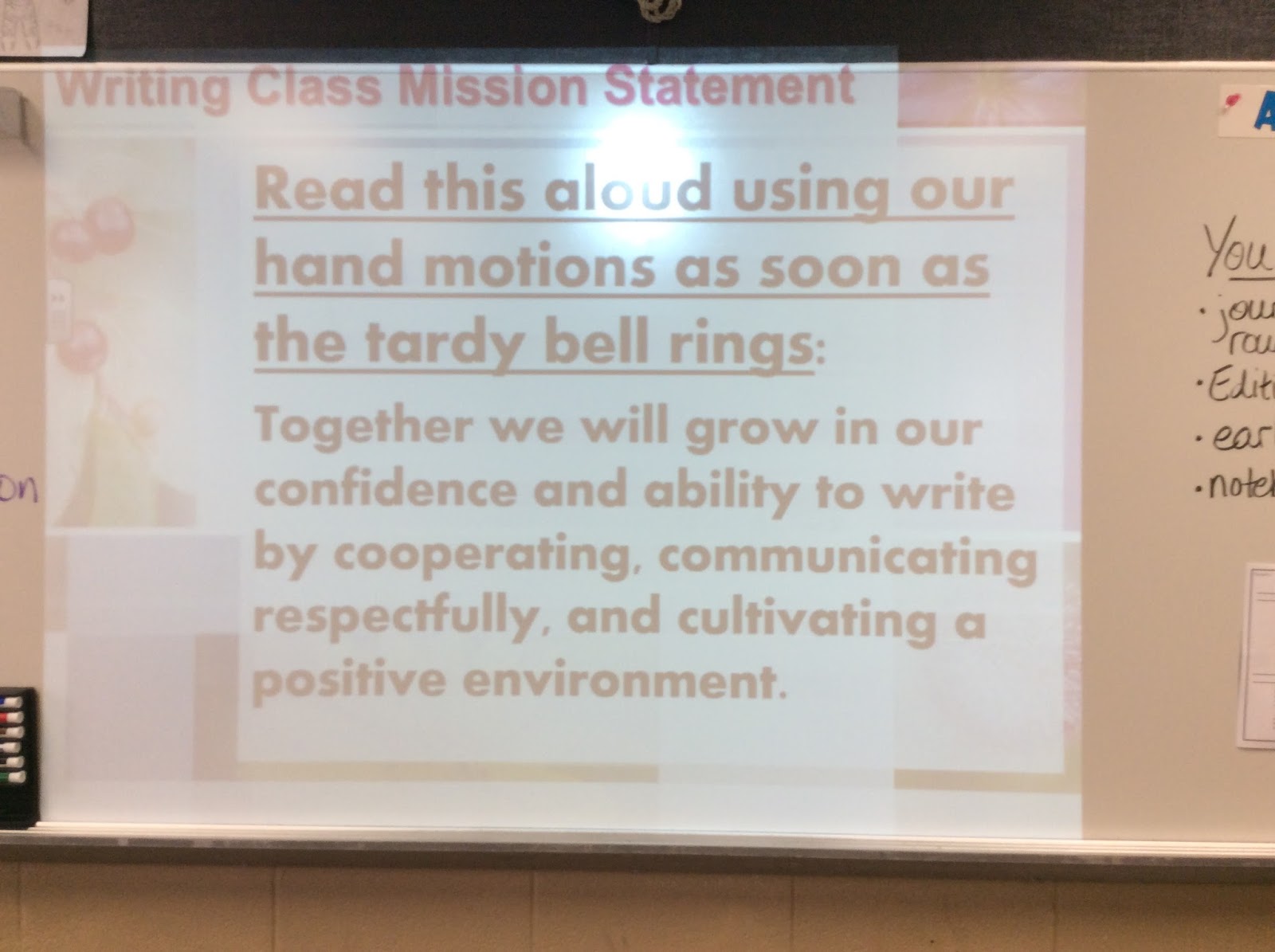
Both teachers and students have embraced this process, drafting and revising missions, pledging their commitment with a signature, and revisiting the mission at the start of each class or PLC.  Some classes have even taken it a step farther, using TPR (Total Physical Response) to attach active meaning to the words of their mission.  TPR is a brain-based learning strategy that will help these students really connect to their goals in each class.  You can watch students in Mrs. Hutson's 7th Grade ELA and Mrs. Grosenbach's ELAR classes using gestures in the videos below, and read some examples of the hard work done these first few weeks of school.

Classroom Mission Statements

Students collaborated to develop their class mission statements across the campus.

Mrs. Hutson's Class Mission Statement
Watch students recite their class mission below.


Mrs. Grosenbach's Class Mission Statement
Watch students recite their mission statement below.


Department Mission Statements

Wondering what the department mission statements are?  Here you go.


Reminder - all classes should have mission statements posted ASAP, if not already.  Also, developing a mission statements with your classes is only a first step. These must be revisited throughout the year, used as a touchstone to guide decision-making, to truly impact student learning. More to come on this as the year progresses!


Falcon Focus: Band Weekly Webinars

As I was scrolling through my Twitter feed a couple of weeks ago, I stumbled upon a retweet by @tersadavis.


Ummm...this is so cool!  What a fantastic (and entertaining) way to share expectations and information with students and families.  Mr. Lewis and Mrs. Serrano used iMovie as their video tool, and plan to continue posting webinars each Friday evening.  The videos even have special effects!


Follow the antics of Mr. Lewis and Mrs. Serrano on Twitter @NRichlandBand and be sure to subscribe to their YouTube channel for band updates.

If have any questions or would like some help implementing these or other strategies, please let me know.  And remember...


It's a great day to be a Falcon!

ThingLink: Portrait of a Graduate